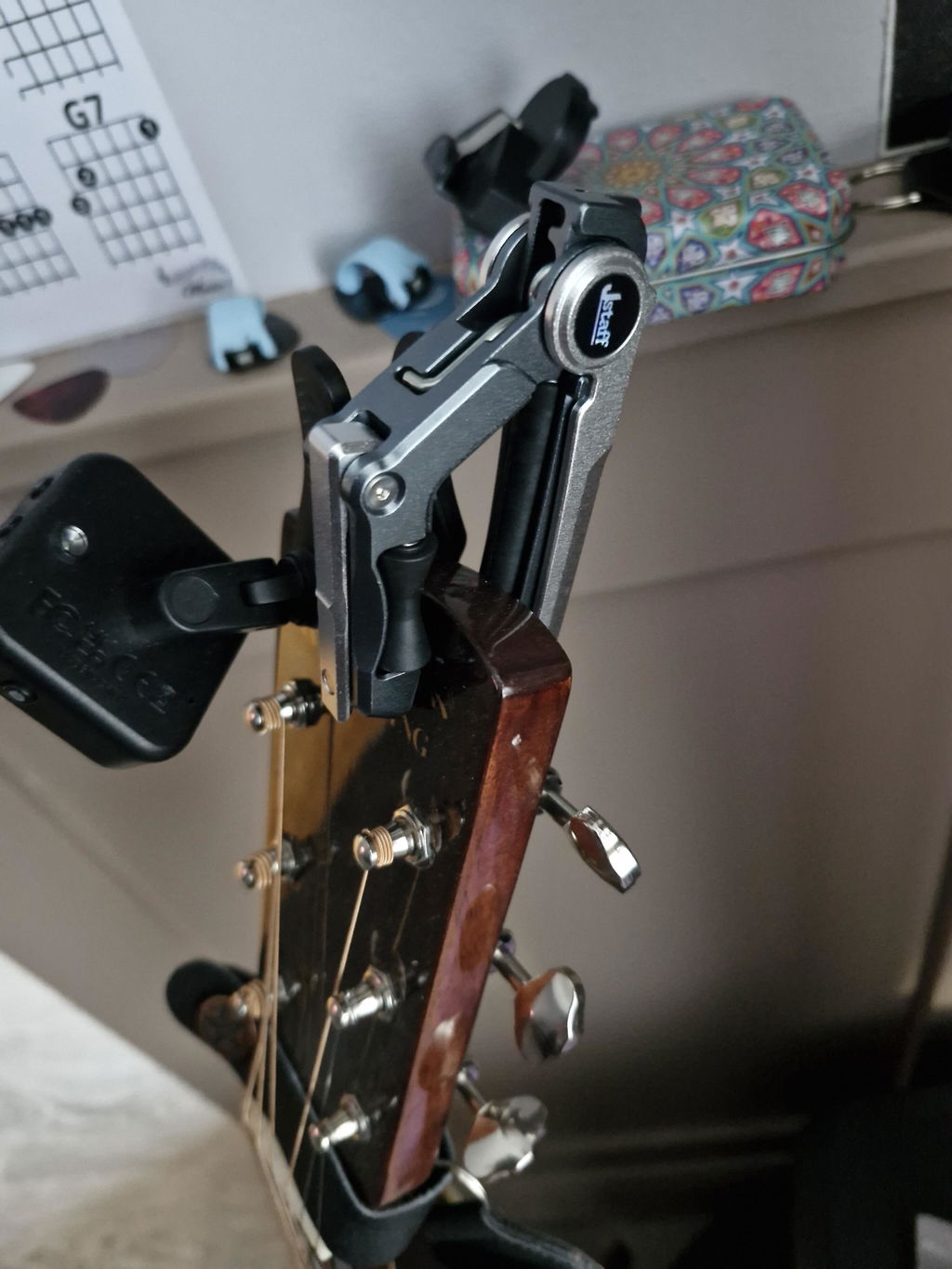
How to tune a guitar
- Choose Guitar, Bass, or Ukulele, then choose a tuning. Standard E A D G B E is the right start for most guitars.
- Click Turn on microphone and allow access when the browser asks. Nothing you play is uploaded.
- Pluck one open string and let it ring. Start with the lowest, thickest string. Mute the others with your free hand.
- Left of center is flat: tighten that string’s tuning peg. Right of center is sharp: loosen the peg. Turn a little at a time.
- Green means the note is within 5 cents. Tune the remaining strings, then check them again from the highest string back down.
An unplugged electric guitar can be quiet for a phone microphone. Pluck firmly near the mic, or play through an amp at low volume and aim that sound at the phone. A noisy room makes the needle jump. Pause, then pluck once.
Standard guitar string notes
These are the open-string targets for standard tuning at A4 = 440 Hz, from the thickest string to the thinnest.
| String |
Note |
Frequency |
| 6 |
E2 |
82.4 Hz |
| 5 |
A2 |
110 Hz |
| 4 |
D3 |
146.8 Hz |
| 3 |
G3 |
196 Hz |
| 2 |
B3 |
246.9 Hz |
| 1 |
E4 |
329.6 Hz |
Drop D lowers only the lowest string to D2. Half-step down moves every string down one fret, which is the Eb Ab Db Gb Bb Eb set. Open G is D G D G B D. DADGAD is D A D G A D. Bass standard is E A D G. Ukulele standard on this page is G C E A, with the high G.
Flat and sharp
Flat means the string is lower than the target note. Sharp means it is higher. The number under the note is cents: 100 cents is one semitone, the distance of one fret. Within 5 cents the tuner calls the string in tune. If you are more than 50 cents away, the big note shows the nearest pitch and no string is highlighted yet. Keep turning until the right string lights up, then fine-tune to green.
On most headstocks, tightening a peg raises the pitch and loosening it lowers the pitch. Turn slowly so you do not overshoot or break a string. New strings go flat again as they stretch, so expect a second and third pass.
How often to tune
- Tune every time you sit down to play. A few minutes is enough to let strings drift.
- Tune new strings several times on the first day. They stretch under normal playing.
- Tune again after a change in temperature or humidity, or after the guitar has been in a case, a car, or a different room.
- If you perform, check tuning every few songs. One hard bend or a warm stage light is enough to move a string.
After a large correction, check the other strings again. Raising one flat string increases pull on the neck and can drop the strings you already finished. This is most obvious with a new set, or when you move from standard tuning into drop D or DADGAD.
Tune by ear
Each string button plays its target pitch for about a second and a half. Use those tones when you cannot allow the microphone, or as a second check after the needle turns green. Match your open string to the tone, then pluck again and let the tuner confirm it.
Questions about tuning
Does this online guitar tuner work on a phone?
Yes. Tap Turn on microphone and allow access. It works in Chrome on Android and Safari on iPhone over https. If you deny the microphone, use Play under each string and match the pitch by ear.
Can I tune a bass or a ukulele here?
Yes. Choose Bass for E A D G, or Ukulele for G C E A. Guitar includes standard, drop D, half-step down, open G, and DADGAD. Acoustic and electric guitars use the same notes.
What notes are standard guitar tuning?
From the thickest string to the thinnest: E2, A2, D3, G3, B3, E4. Players write that as EADGBE. The tuner above uses A4 = 440 Hz.
Why does the needle jump around?
The microphone also hears ringing strings, room noise, and fret buzz. Mute every string except the one you are tuning, pluck once, and let it ring. A clip-on tuner reads vibration from the instrument and ignores the room. This page listens through the air, so a quieter room is more accurate.
Do you record what I play?
No. The pitch is calculated in your browser. Audio is not recorded, stored, or uploaded.
Why did a string go flat after I finished the others?
Tightening one string adds tension and can pull the neck enough to flatten the others. Check the strings again in reverse order. New strings need this second pass more than old ones.